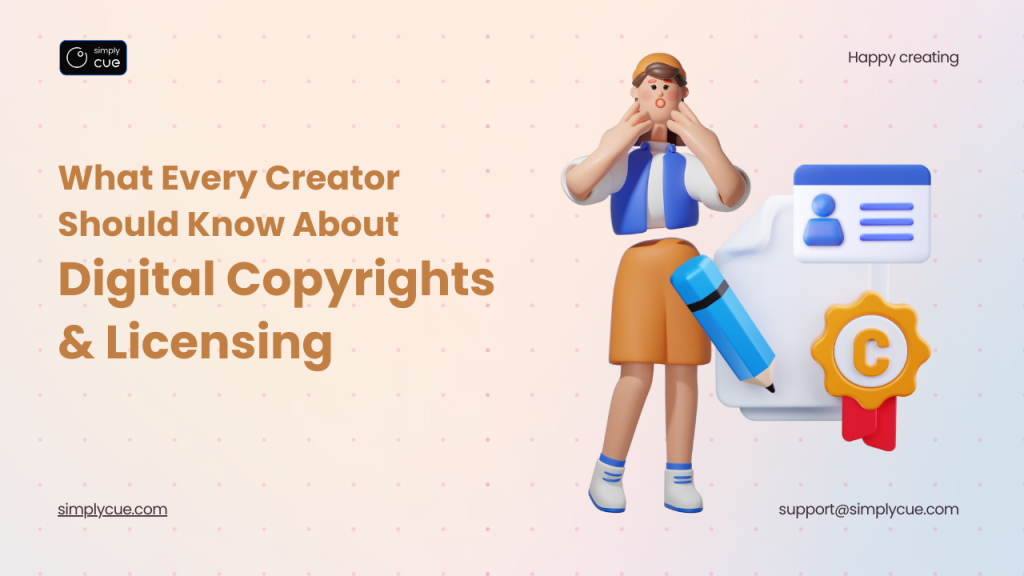
What Every Creator Should Know About Digital Copyrights & Licensing
In the rapidly growing digital economy of today, content has become more than just a medium of expression, it is a valuable digital asset. Whether you’re a YouTuber, Instagram influencer, blogger, musician or visual artist, protecting your content and also respecting others’ rights is a critical skill. But while content creation is booming across India, awareness of legal frameworks still remains low among most creators.
This comprehensive guide will take you through everything you need to know about copyrights, fair use (fair dealing), licensing, common mistakes, tools to protect your creations and best practices, all from an Indian legal and cultural standpoint.
Understanding Copyright in the Indian Context
What Is Copyright?
Copyright is a form of legal protection granted to the creators of “original works of authorship.” In India, it is governed by the Copyright Act, 1957. The moment a creator creates something original and expresses it in a tangible form like a video, blog, poem, photograph, graphic design or music composition it is automatically protected by copyright law.
Under Indian law, you don’t need to register your content to enjoy copyright protection. However, registering your work through the Copyright Office of India gives you strong legal proof in case of disputes.
What Rights Do You Have as a Copyright Holder?
When you create original content, you obtain a set of exclusive rights such as:
- The right to reproduce the work.
- The right to distribute copies.
- The right to perform or display the work publicly.
- The right to license the work to others.
- The right to create derivative works
These rights typically last for the lifetime of the creator plus 60 years after their death.
What Is Fair Use vs. Fair Dealing in India?
Many creators often confuse the term “fair use” (used in the U.S.) with “fair dealing” as recognized in Indian law. While both allow limited use of copyrighted material without permission, fair dealing in India is more restrictive and specific.
What Qualifies as Fair Dealing in India?
According to Section 52 of the Indian Copyright Act, certain uses of copyrighted content are permitted without permission, including:
- Use for private or personal use including research and study.
- Criticism or review of that work or of another work.
- Reporting current events.
- Educational uses by teachers or students.
- Public libraries making limited copies for archival purposes.
What Doesn’t Qualify as Fair Dealing?
- Using music, videos or images for commercial gain without permission.
- Creating memes using copyrighted clips without context of criticism or parody.
- Reposting another creator’s work on social media without transformation or commentary.
- Using copyrighted content in reels or shorts just for aesthetic or background appeal
If you’re monetizing or gaining visibility from someone else’s work, it’s best to obtain explicit permission or a license.
What Is Licensing and Why Does It Matter?
Definition of Licensing
Licensing is when a copyright holder gives someone else permission to use their work under defined terms. These licenses could be:
- Exclusive License: Only one licensee has rights to use the content.
- Non-Exclusive License: Multiple people can use the work.
- Royalty-Free License: You pay once (or nothing) and don’t owe ongoing fees but still need to follow usage rules.
- Creative Commons License: These are pre-defined licenses allowing certain uses (e.g., non-commercial use, credit required, etc.)
Learn more about Creative Commons Licenses here.
What Should You Look for in a License Agreement?
- Scope of Use: What you can and cannot do.
- Duration: How long you can use the content.
- Geographic Limitations: Country-specific use.
- Modification Rights: Can you remix, alter or adapt the work?
- Attribution Requirements: Whether and how you must credit the creator
Misunderstanding licensing terms is a common mistake and can result in takedowns or even legal claims.
Common Copyright Mistakes Made by Indian Content Creators
1. Using Bollywood or Commercial Music Without Rights
It might be tempting to use popular Hindi songs in your Reels or Shorts but doing so without a license can lead to:
- Video takedowns
- Audio muting
- Copyright strikes (especially on YouTube)
- Monetization bans
Instead, use royalty-free libraries like:
- YouTube Audio Library
- Bensound
- Epidemic Sound
2. Reposting Content Without Permission
Many creators make the mistake of downloading and reposting viral videos, artwork or reels without consent or credit. This is still copyright infringement—even if:
- It is not monetized.
- You give credit in the caption.
- The content is publicly available.
The only safe options are:
- Use content under Creative Commons licenses.
- Ask the original creator for written permission
3. Assuming “Free” Means Free for All Use
Free does not mean copyright-free. For example:
- A “free image” from a stock site might require credit to the photographer
- “Royalty-free music” still comes with a license agreement
Always check the terms.
4. Posting the Same Content Across Platforms Without Checking Platform Rights
Each platform has different policies. A duet on TikTok may be legal there but uploading it to YouTube without permission may violate copyright.
The Value of Creating Original Content
The value of your original creation will always supercede any other content. If you create your own videos, audio/music, graphics, blogs or podcasts, you are the legal owner of the intellectual property.
Benefits of original creations include:
- Full control over how your content is used.
- The ability to license and monetize your work.
- Protection under Indian copyright law.
- Greater brand identity and trust.
Understanding Royalty-Free vs Copyright-Free
Royalty-Free
You get a license to use the content without paying recurring royalties but you’re still bound by rules (e.g., no resale, attribution required).
Copyright-Free
Rare. This applies only to works in the public domain (e.g., Rabindranath Tagore’s early poems or ancient texts).Always read the fine print.
How to Protect Your Work from Theft
1. Register Your Work with the Indian Copyright Office
Though not mandatory, registration provides:
- Public record of ownership.
- Evidence in court if someone copies your work.
You can register online at the Copyright Office of India.
2. Use Takedown Services and Notices
If someone uses your content without permission:
- File a copyright infringement notice.
- Use YouTube’s Content ID or Meta’s Rights Manager
- For websites, send a legal notice or a DMCA takedown request (India doesn’t have DMCA, but platforms follow similar procedures)
3. Use Watermarking and Metadata
Add your name or logo on images and videos.
Use tools like:
- Canva
- Kapwing
- ExifTool
4. Track Copying with Digital Tools
- Google Reverse Image Search
- TinEye
- Copyscape
- Originality.ai (for blog and text content)
Legal Remedies Available in India
Despite taking all necessary measures and checks in place if someone copies your work, you can take the steps given ahead to protect your creation:
- Send a legal cease & desist notice
- File a complaint under:
- Section 63 of the Copyright Act
- IT Act, 2000 for digital infringement
- Approach the Cyber Crime Cell or consult an IPR lawyer
Penalties for infringement include:
- Fines up to ₹2 lakh.
- Imprisonment up to 3 years.
Tips for Indian Content Creators to Stay Safe
- Always create with originality—from concept to execution.
- Use royalty-free platforms responsibly and keep documentation.
- Never repost without permission or check license terms.
- Watermark your work and publish only on official channels.
- Stay updated on Indian copyright laws via DPIIT and the Copyright Office.
- Read platform-specific rules for YouTube, Instagram, TikTok etc.
- Seek legal guidance if your work is being stolen or misused
Conclusion: Knowledge Is Protection
In a country as diverse and creative as India, digital creators are the heartbeat of new-age storytelling. But with the rise of content creation comes the responsibility to protect your work and respect others’ efforts.
Knowing your rights as a creator—and using tools to safeguard your content—is not just about avoiding lawsuits. It’s about maintaining your credibility, building a sustainable brand and empowering your journey in the creator economy.
Don’t leave your creative future to chance. Understand copyright, play by the rules and claim ownership of your ideas with confidence.